



Laser Cheval’s expertise in laser micro-welding
In 50 years, Laser Cheval has become a benchmark in the manufacturing of laser machines. To maintain its standing, the company relies on a testing laboratory in Marnay (Haute-Saône) where new paths for innovation are studied. The goal: to push the boundaries of laser micro-welding ever further.
Charly Audemard: Human expertise at the heart of the testing laboratory
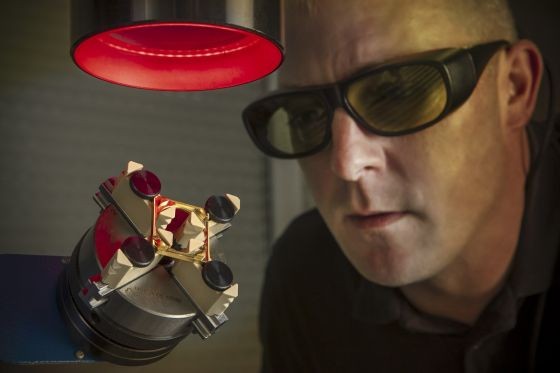
Charly Audemard joined Laser Cheval about twenty years ago, at a time when the SME started designing precision machines featuring laser sources it no longer manufactured itself. “I remember the time when we manufactured lasers from A to Z. Since then, we directly integrate laser sources into our machines,” he says. Over the years, the technician developed solid expertise in the field. He has kept his curiosity intact for a technology that has not yet delivered its full potential, particularly in micro-welding. It is this quest for innovation that drives Charly Audemard in his role as a welding test technician. Welcome to his universe, where high precision is not an option. “In the lab, we perform all the welding feasibility tests on different materials. Recently, I completed micro-welds on products intended for the medical sector. The weld seam was around 60 microns, which corresponds to half the thickness of a human hair. What we are particularly looking for is sealing quality.”
The benefits of laser welding for advanced industries
Precision is not the only competitive advantage of the laser. It delivers an aesthetic execution quality and weld consistency highly sought after in the luxury sector, especially in jewelry and fine jewelry, where attention to detail is paramount. “Unlike brazing, the laser avoids altering the properties of the metal during welding, as the fusion zone is extremely small,” explains Charly Audemard. The result: the original geometry and mechanical properties of the part are fully preserved, without undesirable distortion. Thanks to these performances, this technology is no longer only of interest to the watchmaking industry. Today, for this cutting-edge application, Laser Cheval serves clients across sectors as diverse as medical, aerospace, and electronics.
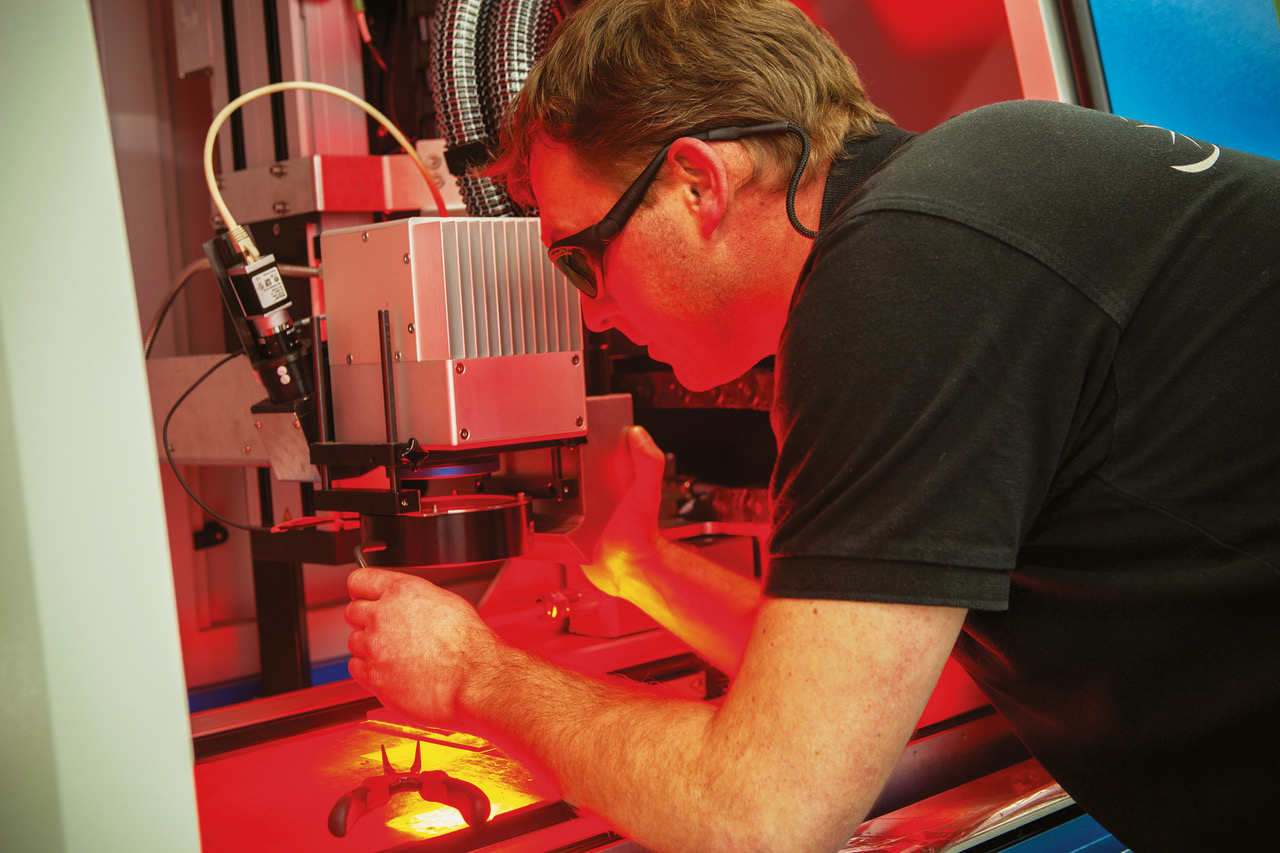
Testing technician at Laser Cheval, Charly Audemard conducts micro-welding tests in his laboratory on different materials
Fiber lasers and custom tooling to process all materials
These developments were made possible by the technological choices Laser Cheval made in recent years. The company uses fiber lasers with an infrared wavelength. Mastering this technology allows it to weld very different materials, including precious materials such as gold (challenging to process in the infrared range) or, in another realm, polymers. “Ten years ago, welding these materials was very difficult. Now, we achieve it by adjusting the optical line and beam quality. We manage to repeat the operation on a large quantity of parts with consistent quality.”
It is this expertise that customers come to seek from Laser Cheval. They entrust their project to the laboratory, which evaluates its feasibility. To achieve this, Charly Audemard goes so far as to create custom 3D-printed tools required to perform the tests. “Tooling accounts for 70% of the success of the work.”
State-of-the-art equipment and energy efficiency: The future of the laser machine
Laser technology is constantly advancing. Laser Cheval continuously investigates new avenues of innovation. The laser machines feature a gas protection nozzle specifically designed to envelop the work area in an inert flow, thereby protecting the weld. Innovation also lies in laser control. “At Laser Cheval, we developed our own OptiWeld software, dedicated to welding operations,” continues the laser testing technician. This software offers an intuitive interface for the operator to control the laser power, ensuring perfect repeatability on every part produced.
However, lasers now benefit from an unexpected advantage that boosts their adoption. In addition to being precise and high-performing for micro-welding, laser technology is also very energy-efficient, unlike brazing. As energy costs become a strategic challenge for businesses, industrial manufacturers find laser machines to be an effective solution to reduce their energy expenditure while increasing the quality of their mechanical joints. This final argument strongly favors laser technology. This context reinforces Laser Cheval’s strategic positioning. By combining the flexibility of its standard machines with optical and software customization, the Marnay-based company reaffirms its role as a key partner in supporting industrial manufacturers through this technological and energy transition.